The most performed laser surgery in the world
Femtosecond LASIK, in detail
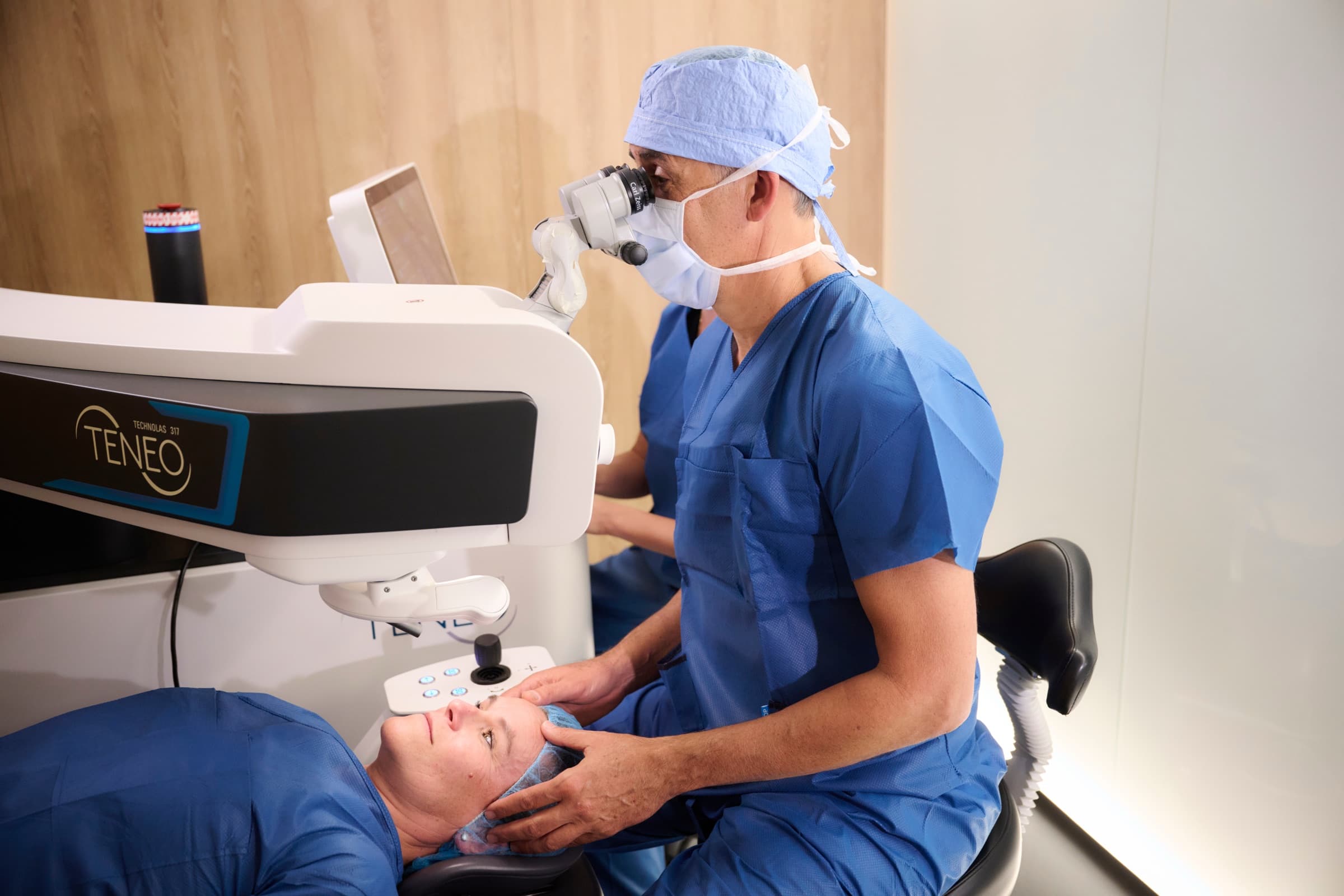
Femtosecond LASIK is the procedure with the fastest visual recovery. After the first phase creates a corneal flap, the laser reshapes the curvature and thickness of the cornea to correct your vision.
The laser procedure takes place in two phases. It is fast (about 15 minutes) and painless.
PHASE 1: Access to the corneal treatment zone (by lifting the surface layer of the cornea).
PHASE 2: Reshaping the corneal curve with laser treatment (flattening it for nearsighted patients and increasing its curve for farsighted patients).
Its main advantages:
- Fast recovery: 100% vision as early as the next day
- Quick return to work (2-day sick leave)
- The thickness, size, centering, and regularity of the flap are programmable with micron-level precision
- State-of-the-art technology
- Fast procedure (15–20 min)
- Eye-Tracker safety system. The laser follows the micro-movements of your eyes, ensuring extreme safety
- Freedom and comfort: 100% clear distance vision over the long term
- Painless procedure. Anesthesia via simple numbing eye drops
Trans-PRK (trans-epithelial photorefractive keratectomy) is a fully laser-based vision correction method that requires no contact with a surgical instrument. Once the procedure is complete, a contact lens is placed on your eyes and kept in place for a few days to ensure better comfort.
Phakic lenses are intended for patients who cannot benefit from laser surgery, mainly due to a correction that is too high or a cornea that is too thin. In that case, a phakic lens placed inside the eye corrects the defect. In cases of presbyopia, the lens that has lost its accommodation is replaced with a multifocal lens that restores vision at any distance without glasses.
Bioptics: this refers to combining laser treatment (LASIK, Femtosecond LASIK, or PRK) with the intraocular implantation of lenses to correct high myopia.